Last week’s bombs in Belgium were a
terrible event. I have spent a lot of time in Zaventem Airport although not so
much in the last few years. The 1980s was my Brussels period and I have fond
memories of it. I had another small flutter of Belgian activity about five or
six years ago and some of the places that I know featured heavily in the TV
coverage. I felt quite nauseous at the sight of some of the scenes.
Despite that I would not hesitate for a
millisecond if business required me to go to Brussels tomorrow. Similarly, I
had no qualms about the prospect of going to Paris in the aftermath of the
Bataclan attack. In this I do not believe that I am significantly different to
the vast majority of my contemporaries across Europe. We are not super heroes.
In fact the vast majority of us are neither super nor heroic, much less both.
We are simply rational human beings who understand that life goes on even if it
is occasionally interrupted by a tragic event. Maybe we also understand a
little about relative risk as well.
How strange then that our friends on the
other side of the Atlantic don’t see things the same way. Donald Trump has
pronounced that “The UK and Europe are not safe places” following the Brussels
atrocities. Where normally we might dismiss anything Trump says as the ravings
of a self-interested idiot he has managed to find himself a substantial
platform in this strangest of all election seasons. My first reaction to his
latest bizarre outburst was one of satisfaction. Maybe it would mean that all
the stupid Americans would stay at home and this year’s tourists would be the
sane and well-informed kind who are always welcome. Since I live close to one
of the major tourist sites in the UK this was really quite a pleasing thought.
My satisfaction didn’t last long. In fact
it lasted about four days. That was when I heard from an American friend who will
not be attending a meeting scheduled for two weeks from now in a European city
that is not Brussels. This is because the company my friend works for has
suspended all employee travel to Europe, supposedly because of a State
Department warning against such travel. I was sceptical about this alleged
warning and when I checked with the State Department web site I found that
indeed there was none such. There is actually an “Alert” – a much lower level
of notification that includes some sensible advice about avoiding angry crowds
and keeping watch on your bags. This is advice that would be applicable in
almost any big city in the world.
Now my friend’s employer is a very large
company. It is a household name and employs large numbers of people who are
very intelligent indeed. So why is it behaving in this way which is not only
stupid but is doing the terrorists’ work for them?
I can only think that it comes back yet
again to the isolation of the USA from the rest of the world community,
exacerbated by the sensationalist and partisan entertainment presented as news
coverage in much of the American mass media. In 2015 over 32,000 people were
shot dead in the USA. That’s almost a thousand
times more than were killed in Brussels. The number of people killed in Europe
by terrorist action has been steadily declining for the last twenty five years
as this graphic from The Independent newspaper shows:
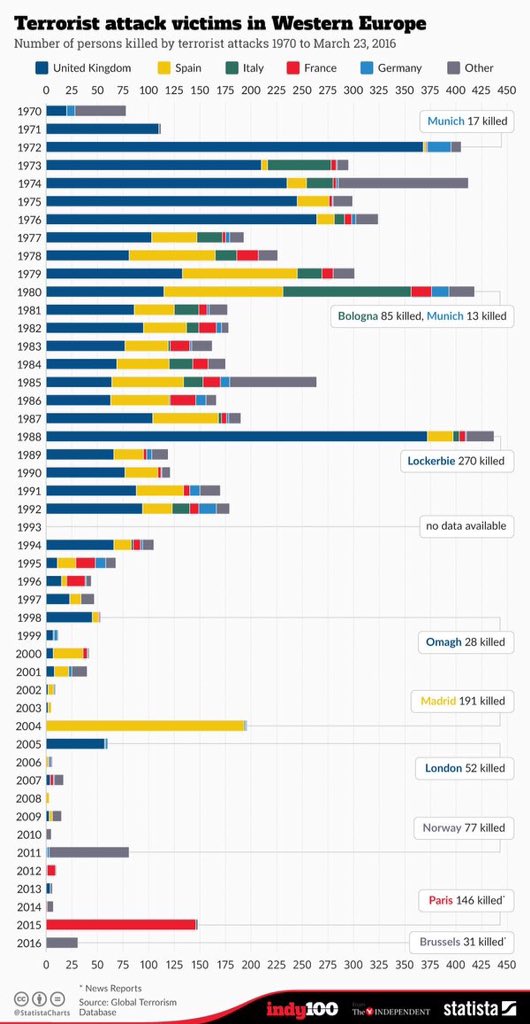
Even in the darkest days of the 1970s and
80s when the terrorist threat in Europe was much higher than it is today it
still killed fewer than one seventh of the number of Americans killed by other
Americans with guns last year. In each of the years from 2012 to 2014, and quite
likely again this year, the number of terrorist victims in Europe was lower
than the number of toddler victims
in the USA (one per week on average). And by the way, this doesn’t refer to
toddlers getting shot. This is the number of toddlers (under three years old)
doing the shooting.
Now this isn’t another polemic about
America’s need for some sort of gun control. That case has been made by better
pundits than me. This is about relative risk and how a major US corporation can
allow its people to move freely around the land of the gun-toting pre-schooler
and yet prevent them travelling to what is statistically the safest region on
Earth. What are the thought processes? Who influences the decisions? When will rational
analysis prevail?
I have no idea.
