Last week the schools were closed for a day in Los Angeles.
Almost seven hundred thousand children missed a day’s education because of a
threat that was received in an email that apparently originated in Germany. The
same email was sent to the authorities in New York and possibly several other cities,
who took very little time to determine that it was not a credible threat. Their
counterparts in Los Angeles took a different line and ordered the closure of
the schools. 1,500 of them were closed and 2,800 law enforcement officers
conducted searches of school premises at a cost of “millions of dollars”
according to City Councilman Paul Krekorian. And 17 year old Andres Perez who should have been in
class was hit by a truck and killed in Highland Park.
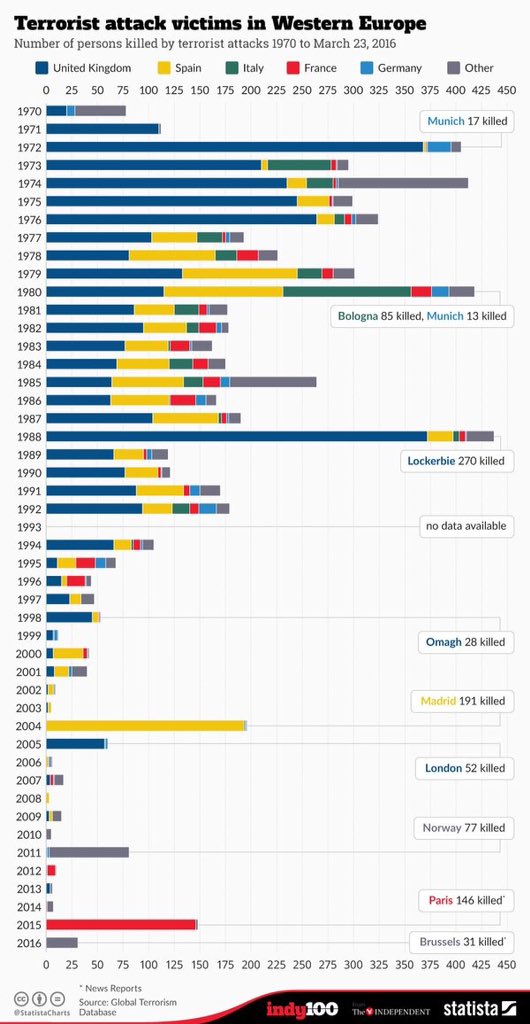
This is just one incident of many that prompt the question –
“What are Americans so scared of?”.
The United States is by an enormous margin the mightiest
power the world has ever seen. Partly that is a function of timing. In their
days the Roman and Chinese Empires and even the British Empire were all as
dominant as the USA is today but they didn’t have the sheer economic and military
muscle that has resulted from two hundred years of the industrial revolution. On
the other hand those earlier empires appeared much stronger than the USA of
today in the confident manner with which they confronted the world.
The Los Angeles school closure is just the latest example of
fear-driven behaviours that have changed life for the worse. Many of them are
irrational and actually cause more damage than the problems they are supposed
to solve. The most obvious of these is the complete political impossibility of
restricting the availability of deadly firearms. Many people in the USA – and I
have met and talked to some of them – genuinely believe that they need a gun
for “protection”. It doesn’t matter how much evidence is accumulated that
owning a gun makes it much more likely that you will be killed by one. The
belief persists and is acted upon.
Some of the behaviours are genuinely risible. For many years
whenever I entered the USA I had to fill in a form that asked a number of
questions about me and my intentions. Did I intend to overthrow the government?
Had I been guilty of moral turpitude? I understand that the questions are
mandated by Act of Congress and would require another Act to change them. They
are still stupid. But in terms of costly stupidity they pale into
insignificance compared to the antics of the Transportation Security Agency. This
panic response to the 9/11 atrocities now employs 55,000 people at a cost of
$7.5 Billion per year and has so far caught not a single terrorist. It is a
colossal waste of resources and the source of enormous frustration to millions
of travellers forced to endure the indignities it visits upon them. And yet it
is politically untouchable. Like the pistol in the bedside cabinet of otherwise
sane Americans it is there “just in case”. Just in case the next terrorist attack
uses exactly the same methods as previous ones. Just in case the completely
impracticable process of producing binary liquid explosives proves to be a real
threat despite all the analysis that has demonstrated that it isn’t. Just in
case an evil-doer might be such a convincing actor that a flight crew would
mistake a child’s water pistol for a real gun.
The fact is that the TSA is untouchable because of fear. The
fear of 435 Members of Congress and 100 Senators that they will lose their
seats if they vote to get rid of it or even to moderate its stupidity. Given
the current state of US politics the fear is probably well-founded.
All of the current candidates for the Republican
presidential nomination are running campaigns based on fear. Fear of “terrorism”
is the most prominent although there seems to be little agreement on how to
actually define terrorism. In the rhetoric of Trump, Carson, Fiorina and all
the others only Islamic terrorism seems to count – in 2015 at least. Another
fear is economic. The fear that other parts of the world are achieving economic
success at the expense of the United States. Fear that living standards are
depressed by an influx of cheap manufactured goods from China and cheap labour
from south of the border. And then there are the truly irrational fears that
improving the lives of historically oppressed groups such as women, ethnic
minorities and gay people will necessarily make things worse for the previously
dominant sections of society.
All of these fears are demonstrably based on falsehoods but
all of them appeal to a certain narrative that is strong in US society. It is a
narrative that will drive the USA down the path that is familiar to any student
of history, the path of the declining empire. Time and again through the ages a
dominant power has faded away because it was unable to adapt to changing times.
Persia, Greece, Rome, Spain, and of course Great Britain all enjoyed their time
of dominance and all faded away when the times changed. In every case the
rulers and the privileged were the last to understand what was happening.
In the 21st century the rules of engagement have
changed compared to the ancient world or medieval times. Obtaining an empire by
military conquest is no longer desirable. The development of nuclear weapons
has made the dream of world conquest in the style of Alexander or Napoleon infeasible.
Extending influence by economic means is the name of the game today. The most
influential great power across Africa today is without doubt China – a country
that has never put a combat soldier in the field outside its own region. And
yet the USA continues to spend more on its military than the combined total of
the next seven major powers. Even if the USA reduced its military expenditures
by 75% there is still zero possibility that its homeland could be conquered by
any conceivable military force. It is said that generals are condemned to be
always ready to fight the battles of the last war. The same may be said for
whole civilisations.
So if all the fears are unfounded why do they persist? To put
it another way, who benefits by keeping the people terrified?
The obvious answer is politicians like Donald Trump. He has
garnered huge support by pandering to the fears of the American people. But in
many ways Trump is just the visible manifestation of a much deeper issue. The
USA, like many Western countries, is about thirty years in to a social
revolution which has reversed a long-term trend. In these countries wealth is
being concentrated into a smaller and smaller group within society. In his book
“Capital in the 21st Century” published last year, Thomas Piketty
demonstrated that this is an inevitable consequence of the essential workings
of capitalism unless it is checked by deliberate government action. Until the
1970s that government action was considered to be a basic responsibility. It
was the mark of a civilised state that its government should support Jeremy
Bentham’s fundamental axiom (See Enlightened Stories) of seeking the greatest
good for the greatest number.
Not any more. Since the 1980s the tide of politics has
turned. Concentration of wealth into a smaller number of hands is not only
acceptable it is the inevitable consequence of policies that have become
mainstream. Regressive taxation which bears down heavily on the poor and
practically bypasses the rich has become the norm. The movement of capital
around the world to exploit low-wage economies at the expense of middle class
people in the US and Europe is an established – and highly lauded – business
strategy. The fruits of the staggering technological developments of the last
hundred years are being apportioned in a manifestly unjust manner.
So why do people put up with it? Why is it impossible for a
politician who advocates a return to Benthamite values to get elected? That’s
where the fear comes in.
George Orwell was one of the great thinkers and writers of
the 20th century. In 1984 his picture of a world divided into three
competing super powers in which populations were controlled by maintaining a
constant state of war rings eerily true today. Of course it didn’t predict
every facet of modern life and of course it would be folly to take it as a
manifesto for today’s world. That said I can’t help thinking of Orwell whenever
I hear a politician talk about the “War on Terror”. There is nothing better
than an open-ended and fundamentally unwinnable “war” to excite the public and
distract it from other political issues that have far more impact on their
lives.
As long as people are fearful they are less likely to be
angry with their leaders. And as long as they aren’t angry about things that
could be fixed then nothing much can change. It suits the immensely wealthy
individuals and organisations that finance politicians to keep the fear
flowing. The mass media are, in general, controlled by the same interests that
finance the politicians. It should come as no surprise that the furtherance of
fear and ignorance is such a big part of their business strategy.
So the United States lives in a constant state of fear. And
yet it doesn’t. On an individual level and at the level of communities the
people of the United States are capable of enormous levels of courage, not to
mention care of the weak and kindness towards strangers. Whether it's the
9/11 firefighters who ran towards the collapsing towers or the bravery under
fire of Chief Warrant Officer Edwin J. Hill, during the Pearl Harbor attack in
December 1941 (If you don’t know about Hill, it’s worth a few minutes of your time
to read his story here) or the every day courage of the families caring for
disabled children across the country, Americans are tough, strong and brave. So
why as a nation do they allow themselves to be ruled by fear? And more
importantly how can they change that?
Those questions are too big for me to answer, especially as
a non-American. Whatever the answers are they have to come from within. One
thing that might help would be more engagement between ordinary Americans and
the rest of the world. It is an often-quoted factoid that only about 5% of
Americans travel overseas each year. That’s not many compared to other developed nations but given
the size of the country and the low number of vacation days that Americans
enjoy it’s not that outlandish. But you don’t have to travel physically to
engage with others. In today’s world it’s easy to see foreign movies and TV, to
play online games with people on the other side of the world and to eat exotic
food from every continent. It’s easy so why don’t many more people do it? Crack
that puzzle and there may be a way to reduce the fear of the unknown.
And then there is religion. For a country with a
constitutional separation of church and state there’s a whole lot of
bible-bashing in American politics. Things might just improve a bit if the
folks who bring you ideas like Original Sin, The Last Judgement and The Rapture
were to confine themselves to the realm of the personal and play less of a part
in the body politic.
Whatever the solution I do have confidence in the American
people that they will eventually find it. There will probably be more bumps in
the road. The fear mongers will have some more successes along the way but if
the USA is to avoid the fate of those earlier empires reason will have to
prevail in the end. And I am a great fan of reason, as I may have mentioned before.